You do not find what you like by thinking about it harder. You find it by trying a few small things and watching how you react. This is five of those things, all doable in a few weeks, none of them requiring you to quit school or quit your job.
One thing worth saying first: plenty of the people around you are guessing too. The only difference is whether the guessing has a method.
Why is it so hard to know what you like?
Because you can only like things you have been exposed to.
Twelve years of school put you in front of maybe ten subjects. University adds a few dozen more, most of them theory. Meanwhile the working world holds thousands of kinds of jobs, and you have only heard about most of them secondhand.
So "I don't know what I like" is usually not a failure of self-knowledge. It is a shortage of data. When you are short on data you go get more; sitting and thinking produces none.
Liking, being curious, and being used to it are three different things
Before you try anything, separate three feelings that get mixed up constantly:
- Curious: you want to know what that job involves. This arrives fast and leaves fast.
- Used to it: you can do the work because you have done a lot of it, but you finish feeling hollow.
- Liking it: you work and time moves faster than usual. You finish and still have energy.
A lot of people pick a career from the "used to it" pile, because it feels safe and other people praise it. Years later they are tired and cannot say why. All five methods below aim at the third pile.
Five things to try over a few weeks
You do not have to do all of them. Pick two, do them properly, then decide what is next.
- Keep an energy diary for two weeks. Every evening write exactly two lines: which task today left you energised, which one drained you. Do not analyse, just write. At the end of two weeks read it in one sitting, and you will see one kind of work repeating in the left-hand column.
- Ask five people you know one question: "What do you think I am best at?" Ask people who have worked with you, not people who only hang out with you. Outsiders usually answer differently from how you see yourself, and that gap is the part worth looking at.
- Recall three times you worked and forgot the clock. They do not have to be big. Write down what the three had in common: were you alone or with people, were you making something new or fixing something broken, were you working with numbers, with words, with your hands, or with people.
- Try one small thing for two weeks. A short course, a personal project, an afternoon shadowing someone in the field. Pick what you are curious about, not what you think is correct. If you are weighing an internship as the way to test something, whether an unpaid internship is worth it has a comparison that can save you months in a place where you learn nothing.
- Read ten job ads across different fields. Underline the lines you would want to do, cross out the lines you dread. Read the day-to-day description and skip the qualifications section. You are looking at what you want to do all day, not at whether you qualify.
Liking it, being good at it, and being paid for it are three separate things
Work that fits you usually sits where three things overlap:
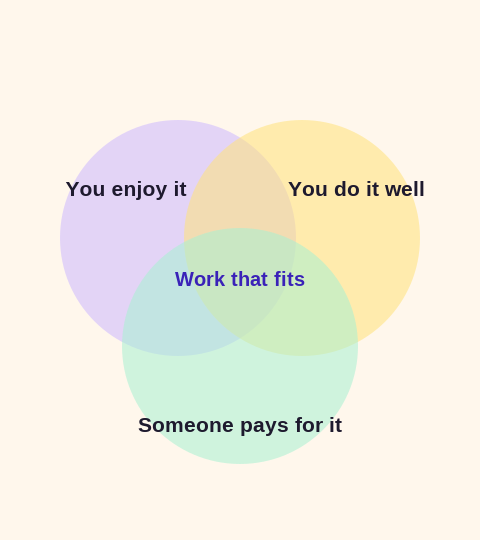
- You enjoy it.
- You are reasonably good at it, or could be after a stretch of learning.
- Someone is willing to pay for it.
You can start with one of them missing. You just have to know which one.
Enjoying something you are not yet good at means you need practice time, and something else paying your rent while you practise. Being good at something you do not enjoy works for a few years and then runs dry. Enjoying something you are good at that nobody pays for is a thing to keep and love, not a thing to make feed you straight away.
What if you try all this and still see nothing?
This happens often, and usually for one of three reasons:
- You tried for too short a time. Two days tells you nothing. Two weeks is where signal starts.
- You tried the surface, not the actual work. Watching videos about design is not the same as sitting down to revise a layout for the fourth time because a client asked.
- You are tired. When you are depleted everything tastes flat. What you need then is rest, not a career decision.
If you are in the third case, rest properly first. Big decisions made on an empty tank are usually decisions you have to make again.
Things you do not need to do
- You do not need to find one job for life. A direction for the next year or two is enough.
- You do not need to love the work from day one. Most people come to like their work after getting good at it, not before.
- You do not need to compare yourself to friends. Someone moving faster is not necessarily moving in a better direction; they just chose earlier.
One small step today beats a month of thinking
Clarity usually arrives after you act, not before.
So if you only do one thing after reading this, make it the first one: write two lines tonight. Fourteen evenings from now you will have something you do not have today, which is real data about yourself.
When you have a few directions and want to test them in order, the 90-day plan for final-year students lays the work out week by week.