Three or six months in and already feeling deflated puts you in very good company. Real work usually looks different from what you pictured in the interview, and boredom at this stage does not tell you much yet.
So do not rush to the conclusion that you picked wrong. The first job is to work out what exactly you are bored with.
Which of these are you in?
The three situations below feel identical from the inside, but call for completely different responses:
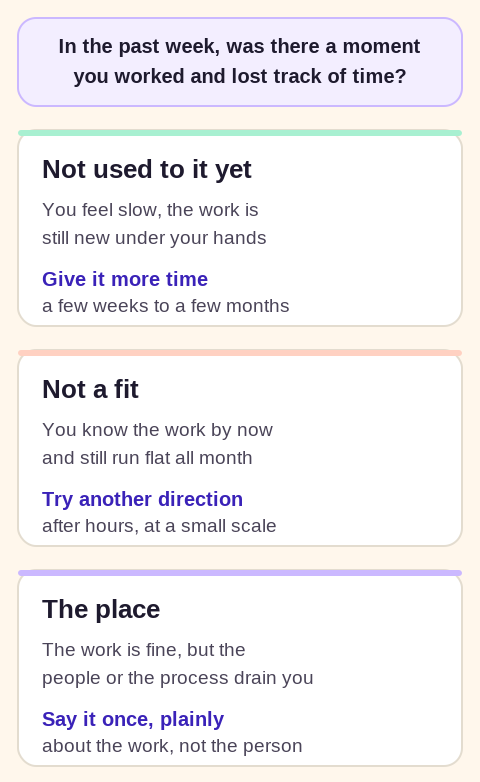
- Not used to it yet: the work is still new, you feel slow and unsure of yourself. This usually eases with time, a few weeks at best, a few months at worst.
- Not a fit: you have found your feet, nothing confuses you any more, and most of the work still drains you.
- The place: the content of the work is fine, but the manager, the colleagues, or the way things get done wears you down.
A quick way to tell: think back over the past week and ask whether there was any moment you worked and lost track of time. If there was, even one afternoon, that part of the work suits you and the problem sits elsewhere. If a whole month has passed with no such moment, you are in the second group.
And if just thinking about one particular person makes you heavy, the third group is your answer.
Four things to try before quitting
Quitting costs months of searching. These four cost a few weeks. Try the cheap thing first.
- Keep a record for two weeks. One line a day about what energised you and what tired you. Read it back after two weeks and you will see the real ratio rather than the feeling of one bad day.
- Talk to your mentor or your direct manager. Say which part you want to learn more of, and ask whether you can take on work closer to it. Many people skip this step because they think speaking up invites judgement. In practice most managers like people who volunteer for harder work.
- Ask someone two or three years ahead of you, in your company or your field. Ask whether they were bored back then and what they did. Their answer usually tells you how long this phase normally lasts.
- Try another direction outside work hours, at a small scale. The point is not to jump immediately, it is to have real data instead of a guess. Plenty of people try and discover their current job is not as bad as they had decided.
If the problem is people, not work
The third group needs a different approach, so here it is separately.
- If it is mismatched working styles: say it once, plainly, about the work and not about the person. "I need two days' notice on a deadline to get it done properly" lands better than "you give me work too late".
- If it is one difficult person: reduce the surface area. Move exchanges to messages or email so there is a record, ask short questions, confirm clearly.
- If it is the culture of the whole place: a newcomer almost never changes that. Preparing an exit is reasonable.
One line needs drawing clearly: if you are being treated unfairly, insulted regularly, or asked to do something improper, none of the exercises above apply. What you do then is record the evidence, talk to a senior person you trust, and prepare to leave.
And if for months now you have been sleeping badly, unable to eat, or carrying the weight into your days off, tell a real person — a friend or someone at home. That is bigger than a question about careers.
When should you seriously consider leaving?
When you have tried the four things above over a few months and still are not learning anything, or when the problem falls under the unfair treatment described above.
But leave with a way out prepared. That means two things:
- Savings enough to live on for a few months.
- At least one direction you have actually tested, rather than one you are daydreaming about.
If your main reason is income rather than the content of the work, when low pay is reason enough to go sits closer to your case.
Does leaving early hurt your CV?
One early move is usually not a big problem, as long as you can say clearly why and what you learned.
What recruiters mind is repeated moves with no clear reason. So if you decide to go, have a three-part answer ready: what the job gave you, where it did not fit, and what you are looking for next. Keep it short and do not list the old place's sins. How to answer the weakness question runs on exactly that principle.
The first six months are a phase, not a verdict
Almost nobody loves their first job. Most people come to like their work after getting good at it, and getting good takes time.
So this week's task is not deciding whether to stay or go. It is writing two lines each evening, for fourteen evenings.